
Smile Design Cases
Smile Design Cases
Smile Makeover Toronto: Solving Severe Crowded Teeth Without Orthodontics | A Cosmetic Dentistry Case Story

Case 78
Case 78
Cosmetic Dentist Toronto Case Study: Solving Severe Crowded Teeth Without Orthodontic Treatment
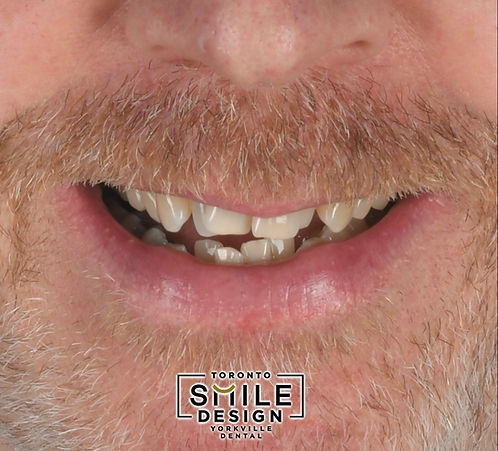
Portrait Smile Before Treatment
At Toronto Smile Design – Yorkville Dental, not every smile story begins with a simple request for whiter teeth or straighter edges. Sometimes, a patient arrives with a far more complex situation; one that sits at the intersection of bite instability, severe crowding, functional collapse, and a deeply personal treatment preference.
This was one of those cases.

Two-dimensional digital smile design planning with reference lines on teeth, used by cosmetic dentist Toronto to plan smile makeover and porcelain veneers.
A male patient in his 50s came to our office with significant crowding in both the upper and lower jaws. The problem was not limited to appearance. He had severe Crowded Teeth, marked Teeth Malignment, and a crossbite on both the right and left sides. At first glance, the most conservative solution seemed obvious: orthodontic treatment to create alignment, build proper space, and establish a healthier foundation before moving into restorative care.
But this patient was certain from the very beginning.
He did not want orthodontic treatment. He did not want a lengthy treatment timeline. He wanted a fast, efficient, definitive solution—and he made it clear that he understood this would likely require a much more invasive path. That moment shaped the entire case.
In modern Cosmetic Dentistry, that is where the real work begins: not with imposing what the clinician prefers, but with explaining the truth clearly, respecting the patient’s autonomy, and designing a treatment that is both honest and implementable. For patients searching for terms such as cosmetic dentist Toronto, cosmetic dentist near me, or even the best cosmetic dentist in Toronto, one of the most important things to understand is that the right treatment is not always the most conservative in theory. It is the one that is chosen with full informed consent, careful planning, and a deep respect for the patient’s priorities.
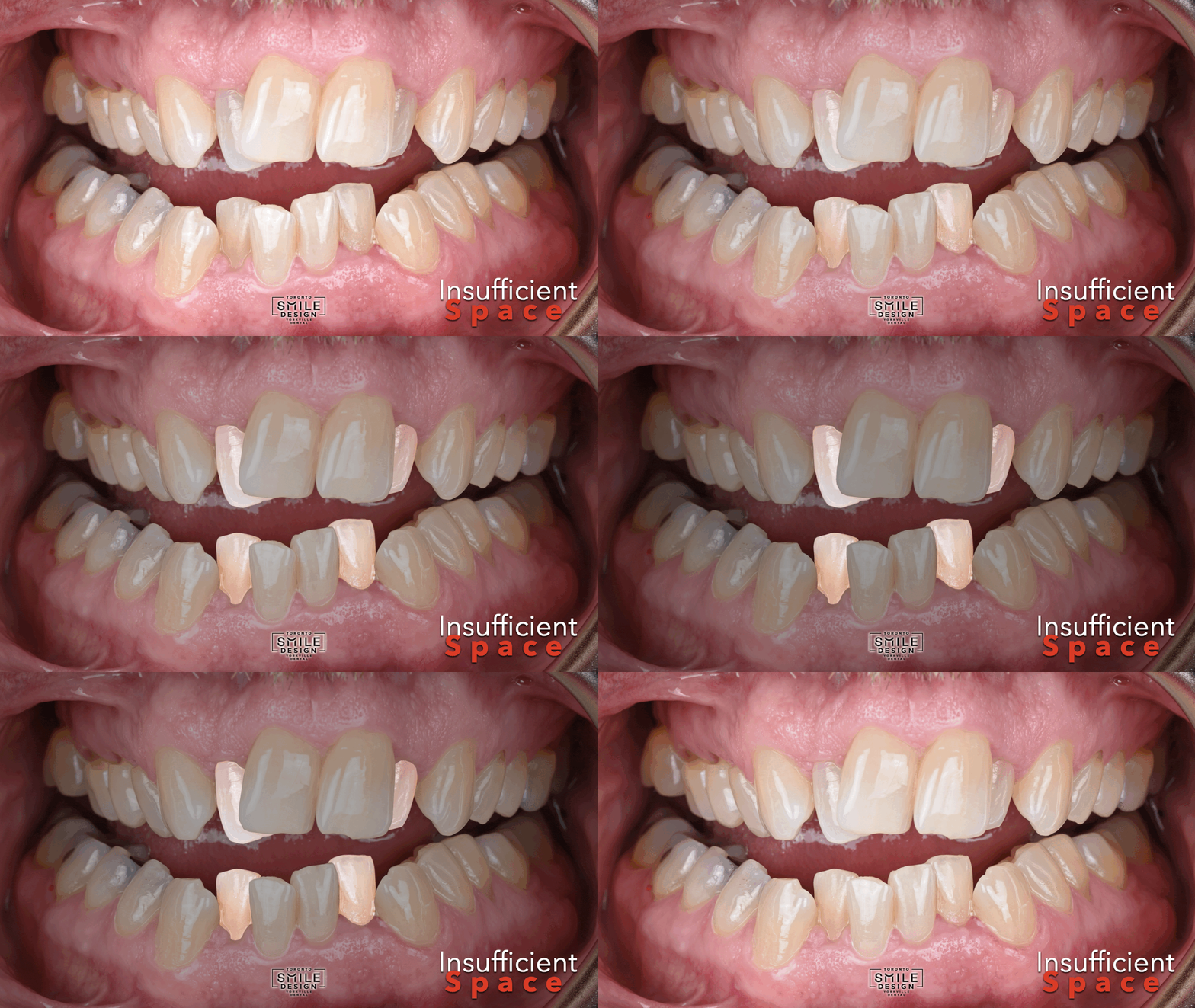
Insufficient Space for the lateral incisors
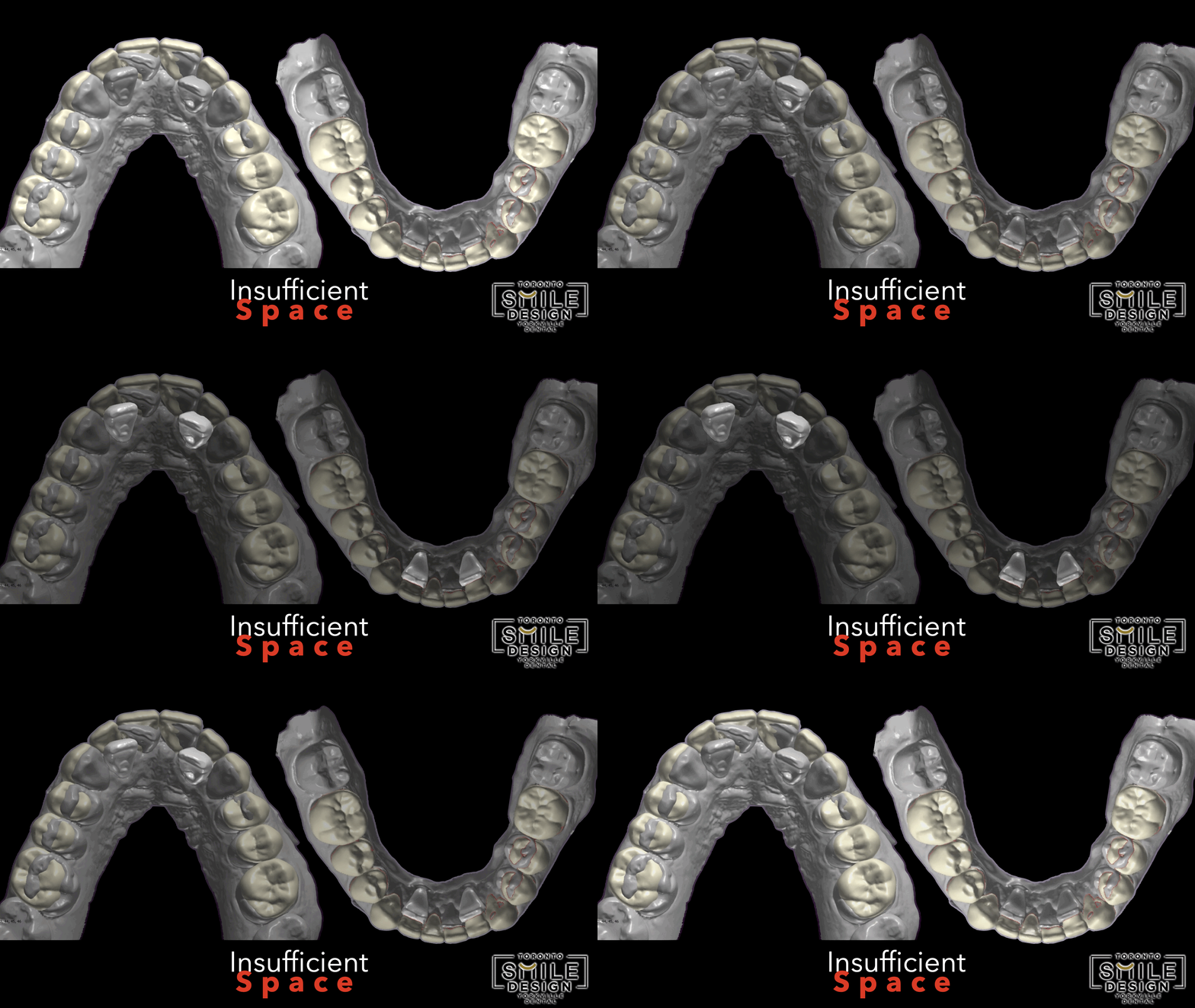
Insufficient Space for the lateral incisors
Patient Autonomy, Informed Consent, and the Reality of Complex Cosmetic Dentistry
Dentistry teaches us to be minimally invasive whenever possible. That principle matters. Preserving natural tooth structure is one of the foundations of responsible care. In a case involving this level of crowding and bite discrepancy, orthodontics would almost certainly have been the more conservative route.
But patient autonomy matters too.
The patient was given all relevant information: the diagnosis, treatment options, the consequences of each path, the benefits and drawbacks, possible complications, and the long-term implications of bypassing orthodontics. He clearly understood that treating tooth crowding without Orthodontic Treatment would not be the most conservative choice. He understood that achieving a faster result would require irreversible treatment. And even after that explanation, he remained firm in his decision.
So the treatment plan had to be designed around that reality.

Malocclusion caused by Malignment

Compromised Function

Compromised Function caused abfractions
To create the space needed for restorative alignment, the plan required the removal of the lateral incisors. At the same time, one of the key strategies for keeping the overall restorative approach as controlled as possible was opening the vertical dimension of occlusion. That step created a restorative room and reduced the need for even more aggressive preparation elsewhere. Once the space analysis was completed, it became clear that the lateral incisor areas were not ideal for implant placement in the context of this case. That meant the final prosthetic design would rely on carefully planned bridgework rather than implants in those specific sites.
This was not a simple veneers Toronto case. It was not just a “make the front teeth look better” case. It was a full smile reconstruction strategy rooted in function, space management, occlusion, and restorative design. In other words, it was a true Smile Makeover Toronto case—but one built on complexity, not cosmetics alone.
Dynamic Jaw Relation During the Centric Relation
Why Digital Smile Design Was Central to This Case
Before any irreversible treatment began, the case had to be proven digitally.
At our office, we believe that treatment should never begin with hope alone. It should begin with records, analysis, simulation, and verification. That is why the first major step was complete digital documentation of the patient. We often describe this as the digitization of the patient—a comprehensive process that allows us to study the smile, bite, function, facial dynamics, restorative limitations, and the feasibility of the treatment plan before anything is done.
Dynamic Jaw Relation During the Centric Relation
Dynamic Jaw Relation During the Lateral Motion
One of the most important parts of that documentation was the MODJAW dynamic jaw-motion analysis. Static photographs and intraoral scans tell one story. Functional jaw-motion records tell another. In this case, the MODJAW analysis revealed that the bite on the right side was extremely traumatic. There was significant buccal cusp-to-buccal cusp contact, particularly in the premolar and molar areas. Those contacts were not harmless. They were contributing to destructive force patterns throughout the mouth, including chipping and structural stress in the anterior teeth.
That finding changed the conversation from “How do we make this look better?” to “How do we rebuild this so it can function properly?”
3D Digital Smile Design Toronto

3D Digital Smile Design Toronto
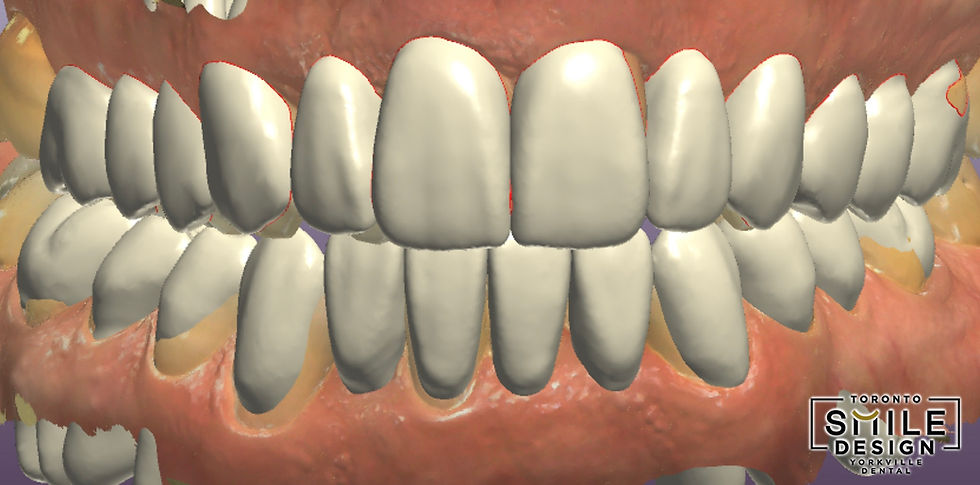
3D Digital Smile Design Toronto
This is the real difference between routine cosmetic work and advanced cosmetic dentistry. A smile does not exist in isolation. Teeth must function in harmony, not just look aligned in photographs. Severe Crowded Teeth, Teeth Malignment, crossbite, and traumatic contacts create a system that wears itself down over time. To correct that system, the treatment plan had to address both the visual and functional problems.

3D Digital Smile Design Toronto

3D Digital Smile Design Toronto
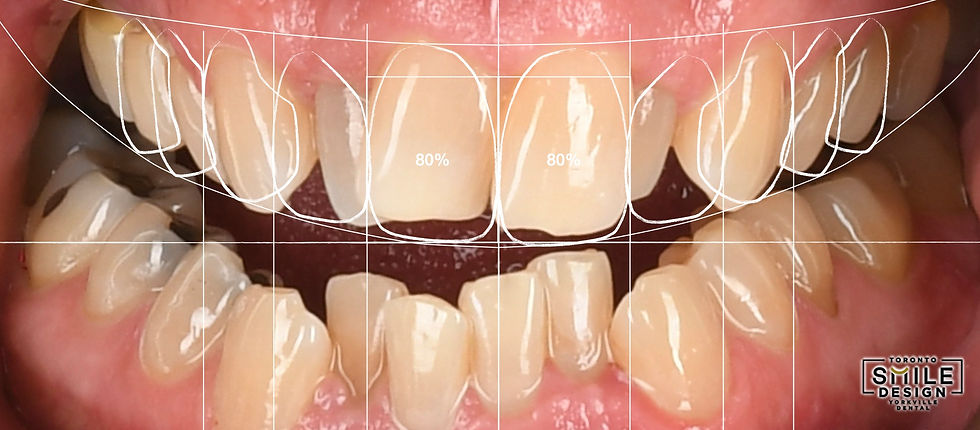
Initial 2D frontal digital smile design overlay planning tooth proportions, incisal edges, and gumline symmetry for a smile makeover
The Prototype Smile: Letting the Patient Test-Drive the Future
Once the case had been studied digitally and the proposed treatment had been proven implementable, we moved into one of the most powerful phases of modern smile design: the prototype smile, or mock-up.
This is where Digital Smile Design becomes deeply valuable for patients. Rather than asking someone to commit to a life-changing treatment based only on diagrams or verbal explanations, we allow them to preview the future result. We call it the test-drive experience. It gives the patient the opportunity to see how the planned outcome may look before fully committing to definitive treatment.
That step matters enormously.

Before and after centre portrait with diagnostic mock-up showing improved tooth proportions and smile design preview
Patients searching for a Cosmetic Dentist or the best cosmetic dentist in Toronto often believe the most important part of treatment is the final ceramic. In reality, one of the most important parts is whether the patient truly understands and believes in the design before the treatment begins. A mock-up transforms an abstract concept into something visible and emotionally real.
For me personally, this phase is especially meaningful because Digital Smile Design is not only part of my clinical practice—it is something I teach internationally. As a digital smile design instructor, I have spent years helping other clinicians understand how to integrate facially driven planning, functional diagnosis, communication, and restorative execution into one seamless workflow. That philosophy guided this case from the very beginning.

Before and after left-side portrait with diagnostic mock-up showing improved tooth display and lip support

Before and after right-side portrait with diagnostic mock-up showing improved smile arc, tooth display, and lip support
The patient did not simply hear about the treatment. He saw it. He experienced it. He understood how the final result could look and how it would fit within the larger plan.
Only after that process, and only after a full treatment plan presentation that covered diagnosis, nature of treatment, benefits, drawbacks, risks, possible complications, and implementation details, did the patient make his final decision to proceed.

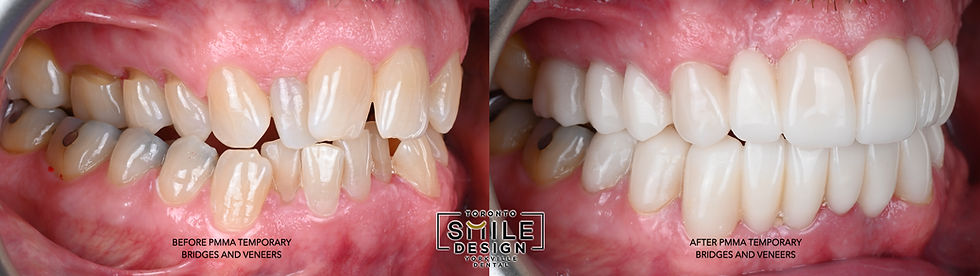
Before and after centre-view portrait with long-term PMMA temporaries guiding gingival healing after the extractions and previewing a smile makeover

Before and after left-view portrait with long-term PMMA temporaries guiding gingival healing after the extractions and previewing smile makeover

Before and after right-view portrait with long-term PMMA temporaries guiding gingival healing after the extractions and previewing smile makeover
The Irreversible Stage: Extractions, Preparation, and Long-Term PMMA Temporaries
Once the treatment plan was accepted, the case moved into execution.
The first major appointment included two crucial steps: preparing the teeth for the planned restorative treatment and extracting the lateral incisors in the same visit. This was the irreversible turning point. The patient had already chosen time over minimal invasiveness, and now the treatment had to honour that decision with absolute precision.
After the preparations and extractions, we fabricated and milled PMMA temporary restorations for the healing period. These were not basic placeholders. They were carefully designed long-term temporaries that the patient would wear for approximately three months while the extraction sites healed.
Before vs after video: smile without and with long-term PMMA temporaries—previewing the new look while guiding gingival healing after the extractions.
This phase is one of the most overlooked parts of high-level Cosmetic Dentistry.
I often say that temporary restorations are dentists' business cards. That belief comes from experience. Patients should not leave the office wearing something that feels like a compromise. Provisional restorations should already reflect the thoughtfulness, precision, and aesthetic intent of the final treatment. In this case, the PMMA temporaries were made as close as possible to the definitive outcome. They allowed the patient to experience something very similar to the final smile during healing.


That offered several advantages.
First, the patient was able to adapt to the new smile design, new bite, and new vertical dimension before the final restorations were delivered. Second, the temporaries gave us invaluable real-world information about aesthetics, comfort, phonetics, and function. Third, they strengthened trust, because the patient was not waiting blindly—he was already living with a version of the result he had chosen.
For anyone considering porcelain veneers in Toronto, a Dental Bridge, a Teeth Bridge, or treatment involving Missing Teeth, this is a crucial lesson: the provisional phase is not a delay. It is part of the treatment. It is where good planning becomes a lived reality.
Screen recording of final restoration design using long-term PMMA temporaries as the blueprint—refining minor discrepancies and elevating aesthetics before final manufacturing.
Final Records, Final Restorations, and a Result That Made Sense
Once healing was complete, the final phase began with another full round of documentation.
That included repeat functional analysis with MODJAW, allowing us to compare the provisional phase with the definitive phase and verify that the function we had created could be faithfully transferred to the final restorations. By then, the most difficult part of the case was not inventing a solution. The difficult part had already happened—during diagnosis, design, simulation, mock-up, and long-term temporization.

Left view of final all ceramic restorations on model showing smile arc and incisal edge design for veneers Yorkville and smile makeover Toronto planning at our dentist Yorkville Toronto.

Right view of final all ceramic restorations on dental model showing occlusion and contour refinement after PMMA temporaries in a cosmetic dentistry Toronto

Centre view of final all ceramic restorations on dental model fabricated from digital smile design Toronto plan for smile makeover Toronto

Left model view of all ceramic final restorations—used to confirm contours, transitions, and smile arc before delivery.

Right view of final all ceramic restorations on dental model showing occlusion and contour refinement after PMMA temporaries

Centre view of final all ceramic restorationson dental model fabricated from digital smile design Toronto plan for smile makeover Toronto
That is why the final stage did not feel like improvisation. It felt like completion.
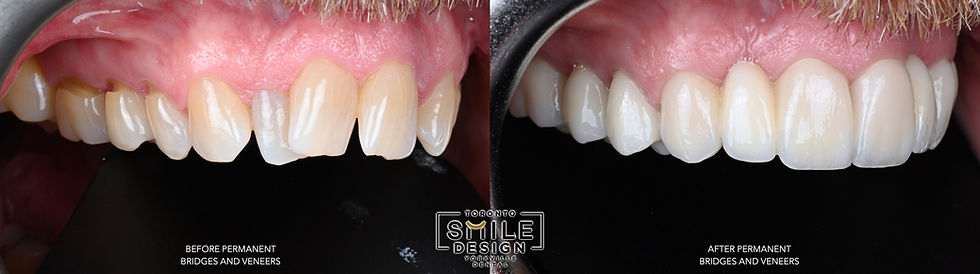
The final restorations were not a guess. They were the culmination of what we had already studied, tested, refined, and proven. And because the process had been handled with discipline from the start, the result delivered exactly what the patient had hoped for. He was extremely happy with the final outcome. There was no pain. There was no sensitivity. The process unfolded as planned because the plan itself had been built carefully enough to succeed.
That is the part of the story that matters most.
The result was beautiful, but it was not magic. It was the product of meticulous planning and precise execution.

Side-by-side before-and-after portrait of patient showing smile transformation with porcelain veneers
Before and after centre portrait showing smile makeover Toronto result with improved gumline symmetry, lip support, and corrected crowding after digital smile design Toronto

Side-by-side before-and-after portrait of patient showing smile transformation with porcelain veneers
Before and after centre portrait showing smile makeover Toronto result with improved gumline symmetry, lip support, and corrected crowding after digital smile design Toronto
Left side before-and-after portrait of patient showing smile makeover with porcelain veneers

Before and after centre portrait showing smile makeover Toronto result with improved gumline symmetry, lip support, and corrected crowding after digital smile design Toronto
Sound-on patient interview + before/after portrait video from a smile makeover Toronto case at our dental clinic Yorkville—sharing her experience with digital planning, long-term temporaries, and final restorations.
SOUND ON!
Before
After


Why This Case Matters
Some people may focus first on the fact that four teeth were extracted. Without context, that can sound dramatic. But context is everything. In orthodontics, extractions—often of premolars—are commonly recommended to create space in crowded cases. So the concept of removing teeth to manage severe crowding is not unusual in itself.
What made this case different was the route the patient chose.
To bypass orthodontic treatment, we had to prepare eight teeth more aggressively than we likely would have if orthodontics had been the starting point. That was explained clearly from the beginning. This was never presented as the most conservative choice. It was presented as the faster choice. And for this patient, that mattered more. By avoiding orthodontic treatment, he saved close to two years. In other words, he consciously chose time over minimal invasiveness.
Before
After


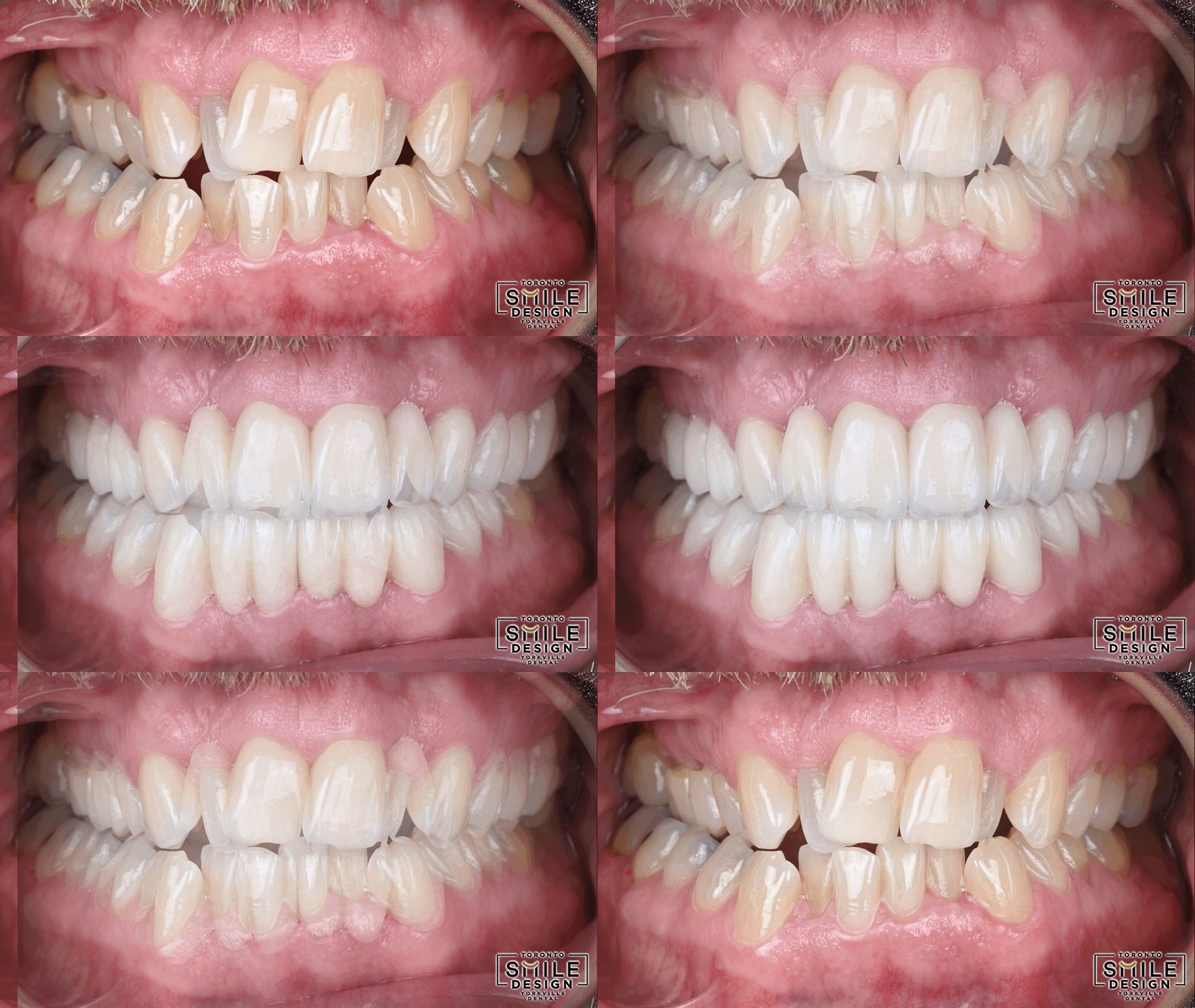
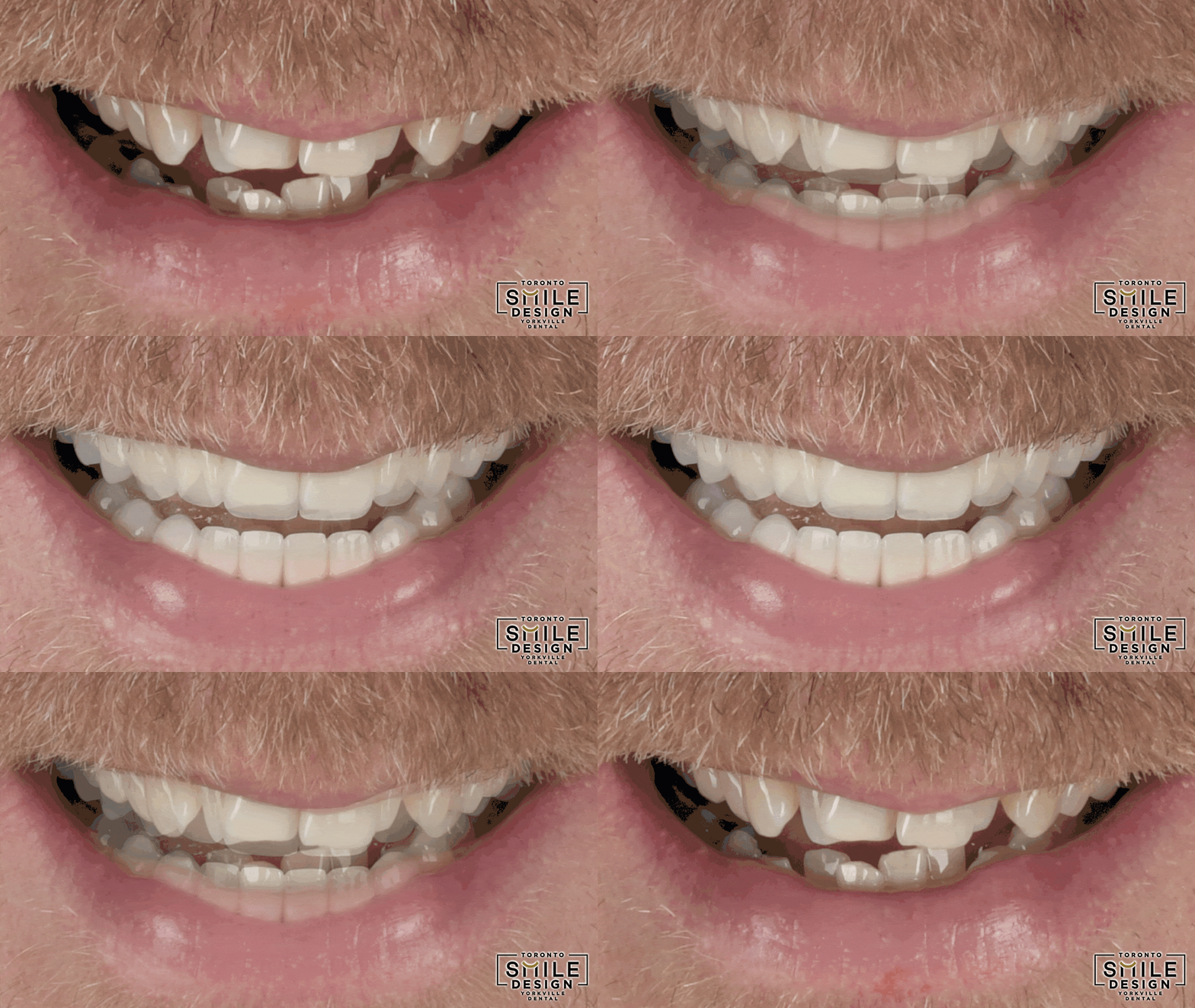
Before and After GIF image of the intraoral situations
That will not be the right choice for every patient.
Some patients with Crowded Teeth, Gum Recession, Missing Teeth, or a failing Dental Bridge may absolutely be better served with orthodontics, implant planning, or a staged interdisciplinary approach. But the goal of ethical Cosmetic Dentistry is not to force every patient into the same roadmap. It is to diagnose honestly, explain thoroughly, document carefully, and allow the patient to choose from genuinely viable options.
At Toronto Smile Design – Yorkville Dental, that is the philosophy behind every major case. We do not rush into treatment. We do not “sell” procedures that cannot be predictably implemented. The most important time in treatment is often the time spent at the beginning—before the handpiece, before the prep, before the commitment. Because once treatment begins, the outcome should already make sense.
In this patient’s case, it did.
Close-up smile photo after treatment showing balanced gumline and refined tooth proportions after smile makeover
He came in with severe crowding, traumatic occlusion, bilateral crossbite, and a firm refusal of orthodontic treatment. He left with a smile that reflected not only aesthetic change, but also function, planning, and personal choice. That is what a truly patient-centred Smile Makeover Toronto should be: not a generic cosmetic upgrade, but a carefully designed solution built around the individual sitting in the chair.
And in the end, that is what made this result so meaningful.
It was not just beautiful.
It was honest, tested, and fully earned.
“You are not entitled to your opinion. You are entitled to your informed opinion. No one is entitled to be ignorant.”
— Harlan Ellison

Smile Makeover Toronto: Solving Severe Crowded Teeth Without Orthodontics Through Meticulous Planning
At Toronto Smile Design – Yorkville Dental, we approach complex smile transformations the same way we approach advanced restorative dentistry: by letting function, facial balance, biology, and long-term predictability guide every decision. Dr. Johnson Ozgur and our team believe that the most successful outcomes are not the result of rushing into treatment, but of spending the greatest amount of time at the very beginning—diagnosing, planning, testing, and making sure the treatment can truly be implemented before any irreversible step is taken.
In this case, a male patient in his 50s to 60s came to our Toronto clinic with severe crowding in both the upper and lower jaws. This was not simply a cosmetic concern. He presented with significant crowded teeth, marked teeth malalignment, and crossbite on both the right and left sides. The initial and most conservative thought was orthodontic treatment, because in cases like this, moving the teeth into proper alignment is often the most biologically respectful starting point.
However, the patient was very clear from the first consultation: he wanted to avoid orthodontic treatment entirely. He wanted the process to be as fast and efficient as possible, even after understanding that bypassing orthodontics would require a much more invasive restorative path. That conversation became the turning point of the case. In our philosophy, patient autonomy matters deeply. Our responsibility is to provide a full diagnosis, explain all treatment options, outline the nature of each procedure, discuss the risks, benefits, drawbacks, and long-term consequences, and then allow the patient to decide which route best fits his values and priorities.
To make that decision responsibly, we first built a complete digital patient. One of the most critical parts of that documentation was the MODJAW dynamic jaw-motion analysis, which allowed us to study the patient’s bite in motion rather than relying only on static photographs and scans. The recordings showed that the bite on the right side was highly traumatic, with buccal cusp-to-buccal cusp contact especially in the premolar and molar regions. These destructive contacts were contributing not only to the malocclusion itself, but also to chipping and overload patterns elsewhere in the dentition. In other words, this was not just a case of crooked teeth. It was a case of aesthetic and functional instability happening at the same time.
Once we had the full digital documentation, we designed the treatment virtually to determine whether the patient’s desired route was truly possible. Because of the severity of the crowding, and because the patient refused orthodontics, creating restorative space required extraction of the lateral incisors. To make the restorative treatment as controlled and minimally aggressive as possible under those circumstances, another important part of the plan was opening the vertical dimension of occlusion. That created additional room and helped reduce how much tooth reduction would be needed elsewhere. Since the lateral incisor areas were not suitable for implant placement in the context of this case, the final prosthetic solution was designed with bridgework extending from the central incisors to the canines.
Before beginning treatment, we translated the plan into a Digital Smile Design workflow and created a prototype smile for the patient. This is one of the most powerful stages of modern cosmetic dentistry. Rather than asking patients to commit to a major treatment based only on explanation, we allow them to test-drive the proposed result through a mock-up. This lets them see how the new smile could look and feel before making a final commitment. As someone who teaches Digital Smile Design internationally, Dr. Johnson Ozgur places a strong emphasis on this phase because it transforms treatment planning into something visible, testable, and far more predictable for both dentist and patient.
Once the patient approved the design, we proceeded with the first irreversible step: preparation of the teeth for the planned restorations and extraction of the lateral incisors in the same appointment. After that, we delivered milled long-term PMMA temporary restorations to guide healing during the approximately three-month healing phase. These temporaries were not simple placeholders. They were designed to be extremely close to the intended final result. We often say that temporaries are the business cards of dentists, because the quality of the provisional phase reflects the quality of the final philosophy. In this case, the long-term temporaries allowed the patient to live in a version of the future smile while the extraction sites healed, while also allowing us to evaluate aesthetics, function, comfort, and adaptation in real life.
After healing was completed, we repeated the documentation process—especially the functional records with MODJAW—to verify that the successful temporary phase could be accurately transferred into the definitive restorations. By that stage, the final phase was not about inventing a result from scratch. It was about completing what had already been carefully studied, tested, and validated. This is why the final delivery felt so smooth: the difficult part of the case had already happened at the beginning, in the planning and execution of the blueprint.
The final result delivered exactly what the patient had hoped for. His smile was dramatically improved, the crowding was corrected, the restorative design was harmonious, and the bite was stable and comfortable. There was no pain, no sensitivity, and the transition from temporary to final was seamless because the entire treatment had been built around verification rather than guesswork. Most importantly, the patient was extremely happy with the outcome, and his final review speaks for itself.
This case also highlights something important: extracting four teeth in order to create space is not as unusual as it may sound when taken out of context. Orthodontic specialists frequently recommend extractions—often premolars—in severe crowding cases to create space for alignment. What made this case unique was not simply the extractions. It was that the patient chose to bypass orthodontic treatment and accept a more invasive restorative path in exchange for saving close to two years of treatment time. In other words, he consciously chose time over minimal invasiveness.
That will not be the right decision for every patient. But the role of excellent dentistry is not to impose one answer on everyone. It is to diagnose honestly, plan meticulously, respect patient autonomy, and only proceed with treatment that is truly implementable. At Toronto Smile Design – Yorkville Dental, that is exactly how we approach complex smile transformations: not with shortcuts, but with a planning-first philosophy designed to create stable, beautiful, and deeply personalized results.
If you are dealing with crowded teeth, teeth malalignment, bite problems, or you have been told that orthodontics is your only option, our Yorkville team can help you understand all of your possibilities. Whether the right answer is orthodontics, restorative treatment, or a carefully coordinated combination of both, the first step is always the same: complete diagnosis, honest communication, and a treatment plan built around what is biologically sound and personally right for you.
